
Raphael Rooms — Guide to All Four Rooms
School of Athens, All Four Stanze & What to See
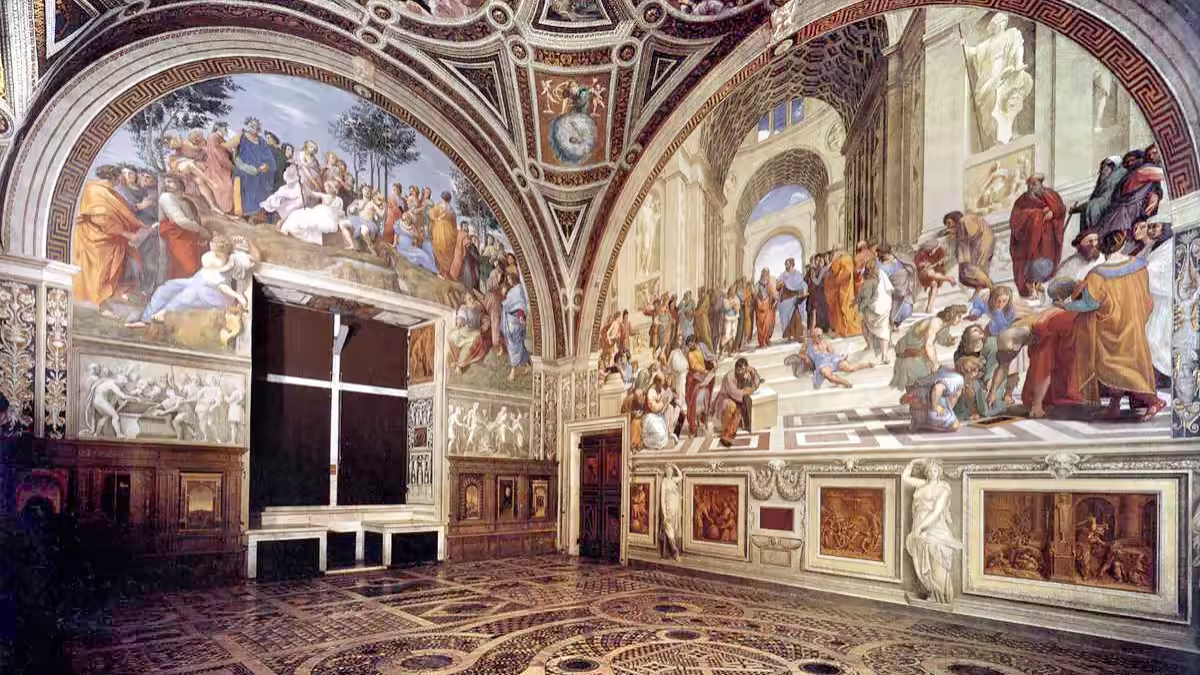
The Raphael Rooms (Stanze di Raffaello) are four interconnected rooms on the upper floor of the Vatican Museums decorated by Raphael and his workshop for Popes Julius II and Leo X between 1508 and 1524. They are among the most important fresco cycles in Western art. The four rooms are: the Room of the Segnatura (containing the School of Athens), the Room of Heliodorus, the Room of the Fire in the Borgo, and the Hall of Constantine. Photography is permitted throughout. Allow 35–45 minutes for a thorough visit.
The Raphael Rooms are the Vatican’s second great fresco cycle after the Sistine Chapel — and in some respects a more integrated artistic achievement. Where Michelangelo’s ceiling is a single artist’s overwhelming individual vision, the Stanze are a sustained collaboration between Raphael’s extraordinary compositional intelligence and the specific theological and political needs of two consecutive popes. Each room is a complete programme of ideas rendered in fresco.
Top Tickets
Room 1 — Room of the Segnatura (Stanza della Segnatura)
The Room of the Segnatura was the first room Raphael decorated (1508–1511) and contains his greatest achievement: the School of Athens on the north wall and the Disputation of the Sacrament (Disputa) on the south wall. The room was used by Julius II as his private library and study — the four walls represent the four branches of human knowledge: Theology (Disputa), Philosophy (School of Athens), Poetry (Parnassus), and Justice (Cardinal Virtues).
The School of Athens — The Most Famous Fresco in the Raphael Rooms
The School of Athens depicts an imagined gathering of the greatest philosophers of antiquity in a vast classical architectural space. Plato (in red, pointing upward to indicate the ideal realm) and Aristotle (in blue, gesturing downward to indicate earthly reality) dominate the centre. The contrast between their gestures encapsulates the difference between Platonic idealism and Aristotelian empiricism in a single visual argument.
- Plato (centre left, red robe): Modelled on Leonardo da Vinci — Raphael’s tribute to the older artist. Points upward
- Aristotle (centre right, blue robe): Holds his Nicomachean Ethics; gestures downward toward the earth
- Heraclitus (foreground, alone, leaning on marble block): Added late by Raphael after seeing Michelangelo’s Sistine ceiling — modelled on Michelangelo himself, a tribute to the rival artist working in the chapel below
- Euclid (lower right, bending with compass): Modelled on the architect Bramante, designer of St. Peter’s Basilica
- Raphael himself (far right, looking out): The young man in a black cap at the far right edge — a self-portrait
- Diogenes (on the steps, alone): The Cynic philosopher, sprawled on the stairs — famously indifferent to the world
The Disputation of the Sacrament (Disputa)
The Disputa on the opposite (south) wall is equally large and almost equally significant — but receives far less attention because visitors walk in facing the School of Athens. It depicts the Church Triumphant: in the upper register, the Trinity and saints in heaven; in the lower register, theologians and Church Fathers debating the nature of the Eucharist around an altar. The composition is deliberately symmetrical — the earthly and heavenly spheres mirroring each other. Raphael painted this first; the School of Athens followed.
Parnassus and the Cardinal Virtues
The two smaller walls contain the Parnassus (Apollo and the Muses with poets from antiquity and the Renaissance — Homer, Virgil, Dante) and the Cardinal Virtues (Prudence, Fortitude, Temperance, with Justice above). Less studied than the two main frescoes but rewarding on close inspection — Dante’s presence on Parnassus alongside Homer is a statement about the status of vernacular Italian literature.
Room 2 — Room of Heliodorus (Stanza di Eliodoro)
The Room of Heliodorus (1511–1514) was painted under Julius II and reflects the political crises of his pontificate — each of the four frescoes depicts miraculous divine intervention to defend the Church. The Expulsion of Heliodorus from the Temple (north wall) is the room’s most dramatically composed fresco, with Julius II himself visible on the left watching the miracle. The Mass at Bolsena (east wall) is a masterpiece of colour — Raphael’s response to seeing the luminosity of Venetian painting.
- Expulsion of Heliodorus: The Old Testament scene of Heliodorus being driven from the Temple by a divine horseman — an allegory for Julius II’s defence of the Papal States from political enemies. Julius II is shown being carried in the left foreground on his papal throne
- Mass at Bolsena: A 1263 miracle in which a doubting priest’s host began to bleed — establishing the Feast of Corpus Christi. The fresco’s colour — warm reds and oranges against cool shadows — shows Raphael at his most technically accomplished
- Liberation of St. Peter: An angel releasing St. Peter from prison — lit entirely by supernatural light in three distinct sources (angel’s glow, moonlight, torchlight). One of the first major nocturne paintings in Western art
- Meeting of Leo the Great and Attila: Pope Leo I interceding to stop Attila’s invasion of Rome — completed after Julius II’s death by Raphael under Leo X; the pope’s face was changed from Julius to Leo
Room 3 — Room of the Fire in the Borgo (Stanza dell’Incendio)
The Room of the Fire in the Borgo (1514–1517) was the last room Raphael supervised closely before his death in 1520; much of the execution was by his workshop. The main fresco (Fire in the Borgo) depicts Pope Leo IV miraculously extinguishing a fire in the Borgo neighbourhood with the sign of the cross — a tribute to the reigning Leo X. The room also contains the Battle of Ostia, the Coronation of Charlemagne, and the Oath of Leo III.
The Fire in the Borgo fresco is notable for its inclusion of a figure escaping a burning building on the right — carrying an old man on his shoulders while a woman hands a child down a wall — a composition directly derived from Virgil’s account of Aeneas carrying his father Anchises from burning Troy. This classical reference within a papal subject is characteristic of Raphael’s humanist synthesis.
Room 4 — Hall of Constantine (Sala di Costantino)
The Hall of Constantine is the largest of the four rooms and was decorated almost entirely by Raphael’s workshop after his death in 1520, under the direction of Giulio Romano and Gianfrancesco Penni. The four main frescoes depict events from the life of Constantine the Great: the Vision of the Cross, the Battle of Milvian Bridge, the Baptism of Constantine, and the Donation of Constantine. The Battle of Milvian Bridge fresco covers the entire main wall — a monumental battle painting notable for its dynamism and compositional complexity.
Visitor Tips for the Raphael Rooms
- Enter from the Gallery of Maps end — the standard route takes you through the rooms in order (Constantine → Fire in the Borgo → Heliodorus → Segnatura). This means you arrive at the Segnatura (School of Athens) last — a logical crescendo
- Face both walls in the Segnatura — most visitors spend all their time at the School of Athens and ignore the Disputa opposite. Turn around
- Find Heraclitus in the School of Athens — the brooding figure alone on the steps in the foreground, modelled on Michelangelo. Added late, after Raphael had secretly seen the Sistine Chapel ceiling
- Photography permitted — all four rooms allow photography; no flash, no tripod
- Allow 35–45 minutes — this is enough for a thorough visit of all four rooms. The Segnatura deserves 15–20 minutes alone; the other three rooms 5–10 minutes each
- The Mass at Bolsena in Room 2 — look at the colour, not just the composition. The warm/cool contrast is extraordinary and shows Raphael’s awareness of Venetian painting
Frequently Asked Questions
Where are the Raphael Rooms in the Vatican Museums?
The Raphael Rooms are on the upper floor of the Vatican Museums, reached after the Gallery of Maps on the standard visitor route. They lead directly to the descent toward the Sistine Chapel.
How long do the Raphael Rooms take?
Allow 35 to 45 minutes for a thorough visit of all four rooms. If you are short on time, the Room of the Segnatura (School of Athens) and Room of Heliodorus deserve priority.
Can I take photos in the Raphael Rooms?
Yes — photography is permitted in all four Raphael Rooms. No flash and no tripods.
Who painted the Raphael Rooms?
Raphael painted the Room of the Segnatura (1508–1511) and Room of Heliodorus (1511–1514) closely himself. The Room of the Fire in the Borgo (1514–1517) was largely by his workshop under his supervision. The Hall of Constantine was painted almost entirely by his workshop (Giulio Romano, Gianfrancesco Penni) after Raphael’s death in 1520.
What is the School of Athens about?
The School of Athens depicts an imagined gathering of ancient Greek philosophers in a grand classical architectural space. Plato and Aristotle stand at the centre; their contrasting gestures (Plato pointing up, Aristotle gesturing down) represent the division between idealist and empiricist philosophy. Over 50 figures are depicted, several modelled on Raphael’s contemporaries.
Related Guides
