
Visiting the Vatican Museums with Kids
Tips, Tickets & What They’ll Love
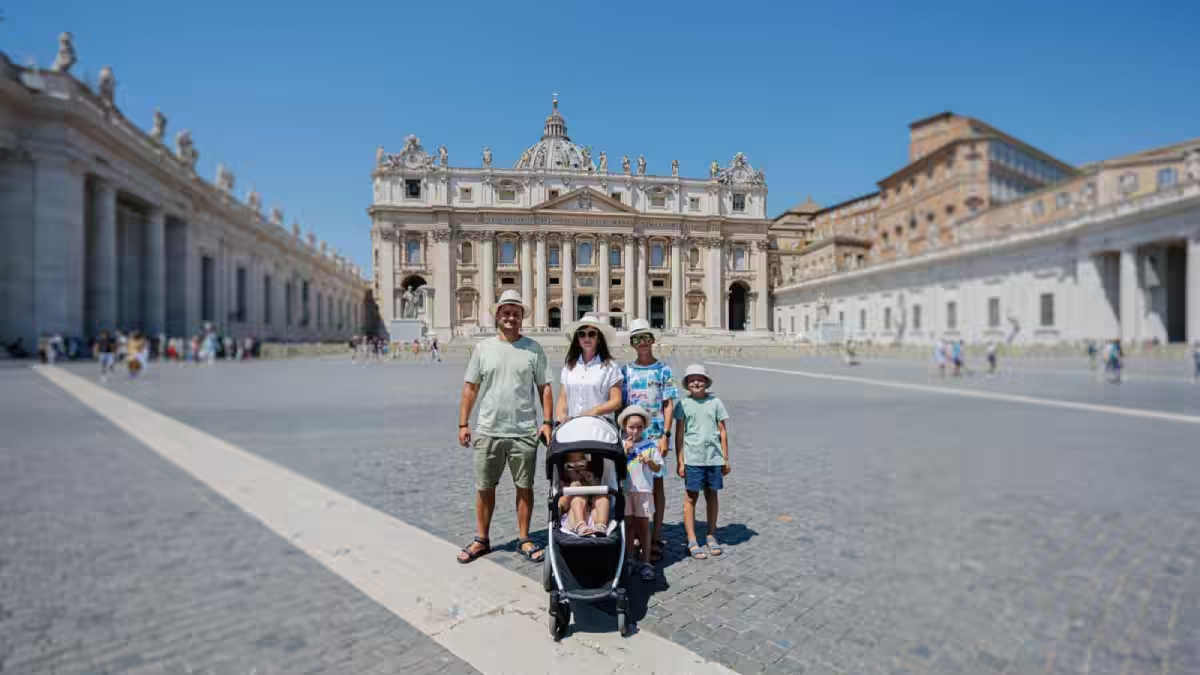
Children under 6 enter the Vatican Museums free with no ticket required. EU citizens aged 6–17 receive a 50% concession. Strollers are permitted in all galleries except the Sistine Chapel (stroller parking is provided at the entrance). Free wheelchairs are available at the cloakroom for children with mobility needs. The Vatican Museums are genuinely child-friendly — mummies in the Egyptian Museum, dramatic ancient sculpture, and Michelangelo’s painted ceiling are among the most visually compelling experiences in any European museum for children of all ages.
The Vatican Museums are not the obvious choice for a family trip — 4.8km of galleries, strict rules, and crowds that can overwhelm adults let alone children. But approached correctly, with a short focused itinerary, an early morning start, and a guide or audio commentary that speaks to children’s interests, a Vatican Museums visit can be one of the highlights of a Rome family holiday.
This guide covers ticket prices for families, the practical rules (strollers, bags, dress code), what children of different ages tend to engage with most, and the best family-friendly tour options.
Top Tickets
Ticket Prices for Families
Children under 6 enter the Vatican Museums free — no ticket required, though they must be accompanied by a ticketed adult. EU citizens aged 6–17 receive a 50% concession on the standard entry price at the official Vatican Museums site. Non-EU children aged 6 and over pay the standard adult rate unless a guided tour product offers a separate child price. Always check the specific ticket product — concession rules vary between the official site and third-party platforms.
| Visitor | Price | Notes |
|---|---|---|
| Child under 6 | Free | No ticket needed; must be with a ticketed adult |
| EU citizen, 6–17 years | from €20 | 50% concession — valid EU ID or passport required |
| Non-EU child, 6+ years | from €39 | Standard adult rate on official site; child rates on some tour products |
| Adult (18+) | from €39 | Standard self-guided skip-the-line entry |
| Guided family tour | from €75 adult / varies per child | Many operators offer child-specific pricing |
Strollers — What You Need to Know
Strollers are permitted throughout the Vatican Museums galleries. At the Sistine Chapel entrance, there is a designated stroller parking area — strollers are not permitted inside the Chapel itself. Elevators are available on all floors and are accessible for strollers. The main entrance area has sufficient space to manoeuvre a pushchair through security and the ticket validation corridor. Double buggies and large travel systems are technically allowed but can be difficult to navigate in the Sistine Chapel corridor and some narrower gallery sections during peak hours.
- Strollers permitted: All galleries, escalators, and elevators
- Sistine Chapel: Strollers must be parked at the designated area at the entrance to the Chapel — not inside
- Elevators: Available on all three floors; accessible for pushchairs
- Cloakroom: Large travel systems and oversized buggies that exceed 40×35×15cm folded must go to the cloakroom — borrow a free umbrella stroller from cloakroom staff if needed
- Baby changing: Baby changing tables and a nursing room are on the ground floor; changing tables also on upper floor and basement
- Stroller rentals: The Vatican Museums do not offer stroller rentals — bring your own
What Kids Love at the Vatican Museums
Gregorian Egyptian Museum (all ages)
Mummies, sarcophagi, the Book of the Dead, canopic jars, hieroglyphics, and a full-size sphinx — the Egyptian Museum is consistently the most immediately engaging section of the Vatican Museums for children. It is on the ground floor, near the entrance, and requires a short detour from the standard route. Worth the 20 minutes for almost any child aged 5 and up. Younger children (3–5) respond strongly to the mummy cases and the giant sphinx.
Pio-Clementino Museum — Laocoön and His Sons (ages 8+)
The Laocoön group — a monumental marble sculpture of a Trojan priest and his sons being crushed by sea serpents — is one of the most dramatically expressive ancient sculptures in existence. Children who would glaze over in front of a Madonna and Child are typically transfixed by Laocoön. The Apollo Belvedere in the same courtyard provides the contrast: serenely beautiful where the Laocoön is agonised. Allow 20–25 minutes here.
Gallery of Maps (all ages)
The 120-metre corridor of painted maps of Italy is visually spectacular and easy to engage children with: ask them to find Rome, find the coast near where you might be going, or count the maps. The ceiling above the maps is equally elaborate but faces stiff competition for children’s attention from the colourful floor-level maps. Allow them to spot boats at sea, mountains, and cities they recognise.
Raphael Rooms — School of Athens (ages 10+)
The School of Athens is a good opportunity to play a visual game: can you spot Plato (the old man in red pointing upward, modelled on Leonardo da Vinci) and Aristotle (pointing down, in blue)? The figure of Heraclitus sitting alone in the foreground is Michelangelo — added as a tribute by Raphael after seeing the Sistine Chapel ceiling. Most children aged 10+ engage with this once they know who to look for.
Sistine Chapel Ceiling (all ages — approach matters)
Michelangelo’s ceiling is extraordinary, but staring at a ceiling from floor level for more than a few minutes is physically uncomfortable. For children, the key is giving them something specific to find: the finger of God reaching toward Adam’s finger in the Creation of Adam panel is the most famous image in the ceiling and usually the first one children can identify from the entrance. For older children, the nine narrative panels tell the story of Genesis from Creation to the Flood — walking through them in order gives structure to what would otherwise be overwhelming.
The Momo Spiral Staircase — the Exit
The double-helix spiral staircase at the exit — designed by Giuseppe Momo in 1932, with one ramp spiralling up and the other down simultaneously — is one of the most photographed architectural features in the Vatican. Most children find the geometry genuinely fascinating. Point it out as you descend to the exit.
Best Family Tour Options
Family Guided Tour
A family-focused guided tour uses commentary pitched at children rather than adult art historians — stories about the people in the paintings, drama in the Laocoön, the mystery of mummies in the Egyptian Museum. Small-group family tours typically run 2 to 2.5 hours and keep children walking and engaged rather than standing. See our Vatican Museums guided tour page for current options.
Private Family Tour
A private tour gives your family a dedicated guide who can adapt entirely to your children’s interests, pace, and attention span — spending longer at the Egyptian Museum if they love it, skipping sections that aren’t working, and keeping the energy up throughout. Prices start from €330 per group. See our Vatican Museums private tour page.
Self-Guided with Audio Guide
A standard skip-the-line ticket with the official audio guide is a cost-effective family option if your children are 10 and over and can engage with commentary. For younger children (under 8), an audio guide is typically too detailed to hold attention — a guided tour or a well-prepared parent-led visit works better. See our Vatican Museums audio guide page.
Practical Tips for Visiting with Children
- Go first thing — book the 9am entry slot. Children tire faster in crowds; the first hour is the quietest of the day
- Keep it short — 2 to 2.5 hours is the realistic maximum for children under 10. Focus on the Egyptian Museum, Gallery of Maps, and Sistine Chapel; skip the Chiaramonti corridor
- Bring snacks — food is not allowed in the galleries but can be consumed in the cafeteria or at the Pinecone Courtyard Bistro. Bring a refillable water bottle (sealed plastic bottles are permitted in galleries)
- Dress code for children — the dress code applies to all ages: shoulders and knees covered. For summer visits, pack a spare T-shirt and lightweight trousers or leggings for each child
- Comfortable shoes — the visitor route covers 4.8km on hard stone floors. Children’s shoes should be well-fitting and broken in — do not bring new shoes or flip-flops
- Download offline — if using the Vatican Museums app, download maps and audio content before arriving; there is no Wi-Fi or reliable mobile signal inside
- Sistine Chapel rules — no photography, no noise. Prepare children for this in advance; guards enforce silence and will call out parents whose children are disruptive
- Nursing and changing — baby changing tables and a nursing room are on the ground floor near the main entrance
Minimum Age — Is There One?
There is no official minimum age for the Vatican Museums. Infants and toddlers in strollers are welcome and enter free. In practice, children under 3 are unlikely to engage with the galleries but the visit is perfectly manageable if they are in a stroller and content. The Egyptian Museum and Sistine Chapel generate the most natural engagement for very young children, simply through the scale and visual drama of the spaces.
Frequently Asked Questions
Are children free at the Vatican Museums?
Children under 6 enter free with no ticket required. EU citizens aged 6–17 receive a 50% concession. Non-EU children 6 and over pay the standard adult rate on the official Vatican site, though many guided tour products offer separate child pricing.
Are strollers allowed in the Vatican Museums?
Yes — strollers are permitted in all galleries. At the Sistine Chapel, strollers must be parked at the designated area at the Chapel entrance and cannot be taken inside. Elevators and ramps are available throughout. The Vatican Museums do not offer stroller rental — bring your own.
What is the best age to visit the Vatican Museums with children?
Children aged 7–12 typically get the most from a Vatican Museums visit — old enough to engage with the stories and visuals, young enough to find the mummies and dramatic sculptures genuinely exciting. Teenagers often respond strongly to the Sistine Chapel once they understand what they are looking at. Younger children (3–6) can enjoy the Egyptian Museum and the spectacle of the main galleries even without context.
How long should I plan for a family visit?
2 to 2.5 hours is a realistic and satisfying visit for a family with children under 12. A 3-hour visit is achievable with children aged 10 and over. For full timing guidance, see our how long to spend at the Vatican Museums guide.
Is there a family ticket for the Vatican Museums?
There is no combined family ticket on the official site — each visitor is ticketed individually (children under 6 free). Some third-party tour operators offer family packages. See our Vatican Museums tickets for kids and families page for current options.
Related Guides
